17 October 2010

Observations on the oil pipeline, written Jan 5, 2010

During all of my adult life, starting with the lease sale to various oil companies of parcels along Prudhoe Bay by the State of Alaska in 1969 for about $900 million total, oil has dominated our Alaskan economy.


In 1974 Alyeska built the roads and the camps that would accommodate 20,000-plus pipeline workers, including me, for the construction of the pipeline in 1975-77. It was the largest privately-financed construction event of the times, eclipsing anything which had ever happened in Alaska prior to that. It had long-term consequences that effected Alaska unlike any other economic event ever.


Yet those times are almost over. Every year the pipeline pushes a decreasing amount of oil. Presently, it is just under 700,000 barrels a day. As it goes by Copper Center, just 100 miles from its destination at Valdez, the oil has already dropped to about 40 degrees inside that pipe. It is getting dangerously and ominously close to the point where it can no longer function. The latest best estimate gives us ten more years. I am far less optimistic. I believe that unless ANWR is brought on line within the next six years, there will not be enough time left to save the pipeline from becoming just another large industrial remnant of better times.


Yes, I too am closely tied to it and always have been. My first real job after leaving the Army in 1974 was working on that pipeline. I knew it was a historic event at the time. I am sorry I did not take pictures while I was there. It was definitely a one-of-a-kind boom where money was practically flowing through the streets of every place even remotely connected with this project all throughout Alaska--just as it must have been during the glory days of the series of gold rushes that mark the early days of Alaska.


In some ways the pipeline will live on after its demise if our legislators are successful in enshrining our Alaskan Permanent Fund into the Constitution. This will guarantee that the investments realized as a result of our early oil revenues will always go first to the Alaskan people. That remains to be seen, but we all want it. All of us, that is, except those too closely associated with government services, that ravenous monster that knows no bounds and recognizes nothing except the justification for an increasingly expensive and ever-growing bureaucracy. Every state faces a similar fate. For some, such as California, New York and Oregon, the chips are coming due with no way to cover the bets. For us here in Alaska, we still have a chance to escape that fate.


But the days of Big Oil are very obviously in decline for Alaska as the companies lay off an ever-increasing number of its workforce on the North Slope. ANWR may be a politically dead issue. Even though we are no where close to running out of oil, politically oil production in Alaska is probably dead. If so, then the writing is on the wall. Yes it is true. It is almost over. My business is closely tied to it, as are most every one else's who operates year-round here in the interior. We Alaskans are only too fully aware that we must plan for what is coming. Most of us are counting heavily on some form of natural gas line to replace it. However, the Trans-Canada Alcan line will likely never come to be. That is because Alaskan natural gas must compete with huge fields of cheaper gas in Canada and Stateside. No way. We can't do it. Only an all-Alaska line has much of a chance of becoming reality, especially if we gain an export license so we can sell LPG to the Orient. That is where I am placing my bets, at least for now.


Ten years. Maybe more. Probably less. That's it. That's all there is.
Addenda:  Since I wrote this brief piece last year (as part of a larger thread related to pipeline construction camps) I have begun to have serious doubts that we will be building any gas pipeline. I am quite sure that the trans-Canada one is out the window, but I also see little encouraging about the Valdez line, although I remain hopeful. It is all a function of how price-competetive Alaska can be with its LNG gas, assuming it is ever delivered to Valdez. 


Alyeska Pipeline Map: click image for larger version

16 October 2010

The FIVE-YEAR PLAN: Phase II of the Reconstruction of the CRD

The second phase of reconstruction on the CRD building will enlarge the bar itself to enable room for additional activities, mostly tourist-related. But two features will be of particular interest to locals: the inclusion of a band stage and a dance floor for special events.

In keeping with the general theme of the newest part of the model railroad, this new area is deliberately designed to resemble the Brick Tavern as seen in Northern Exposure.  The original building, which is located in Roslyn, Washington, is shown below the model plan for comparison:  


Phase I of re-construction of the CRD building

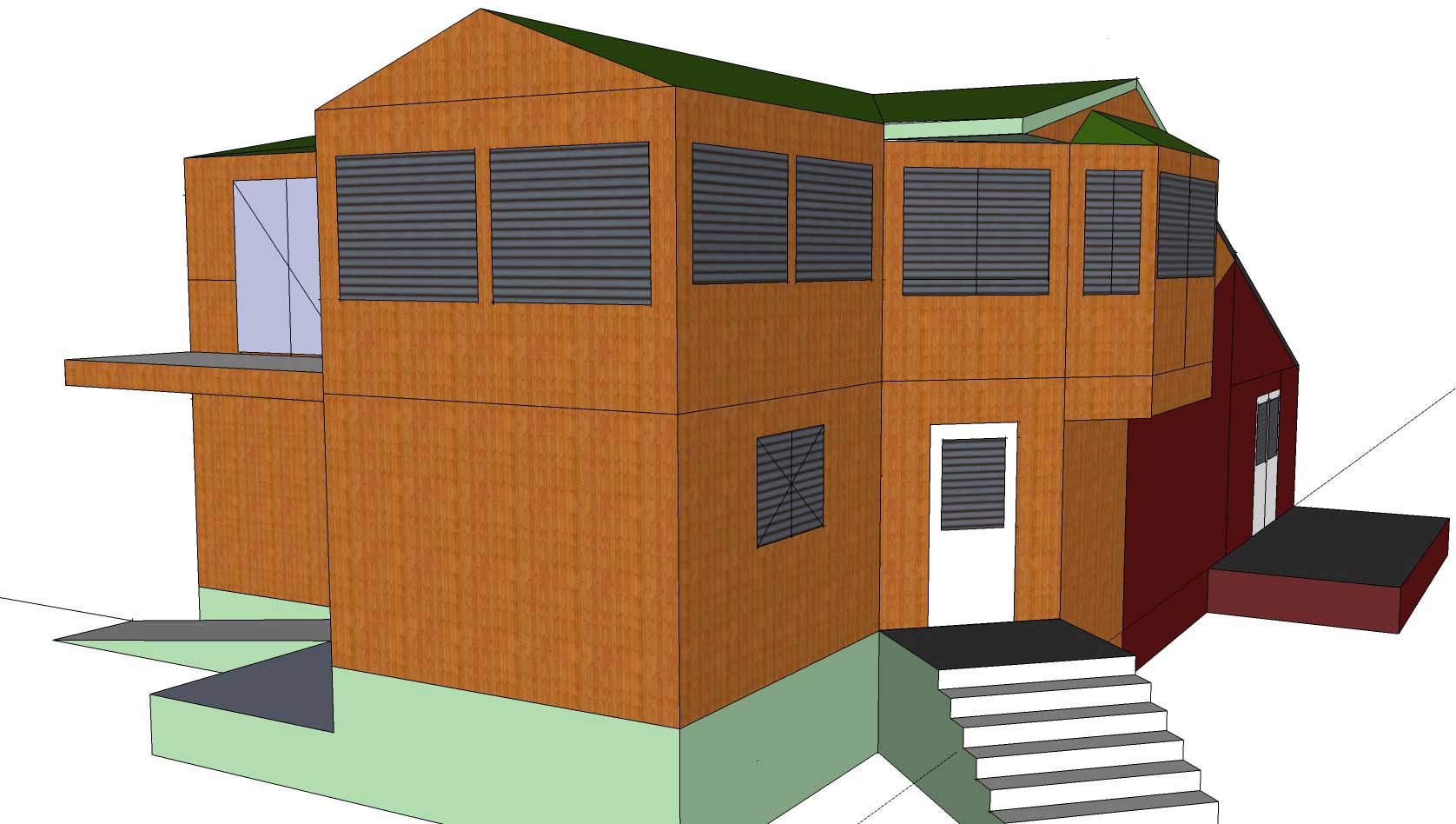
The completed structure, which will be my new residence, will look like this: This phase of construction should be completed sometime during the next summer season. Long-term plans call for a Phase II expansion which involves enlarging the bar area, principally in order to enhance tourist activities.  The red section is the existing Copper Rail Depot bar. Most of the structure you see represented here is already in place. Click any image to view a larger version. 


Ron's Introduction

Hello out there. Allow me to introduce myself.

I am Ron Simpson, born of a Native-Alaskan father and a second-generation Norwegian mother. I grew up in Ketchikan, Alaska, one of those wonderful small towns that probably no longer exists anywhere in the sense that the society that fostered that atmosphere no longer seems to exist. Thus I took with me into adulthood some very strongly-rooted small town USA values.

Ours was a town of mixed population in that it was the home of Tlingits, Haidas and Tsimpsian Indians who made their livings mainly in the fishing and timber industries that once dominated the area. Dad became the local community college director about 1964 after about ten years teaching in the local schools. He always emphasized the need to develop practical and marketable skills. The community college he oversaw represented his philosophy of making such practical educational opportunities available to all who wanted them at a very reasonable cost with the cirriculum presented in ways that fit in well with the community.
Since I first entered high school I took up an interest in politics, especially cold war politics. The communists running the Soviet Union, East Germany, China, Vietnam and North Korea fascinated me. I never could understand how such atrocious people could get away with enchaining entire nations and then proceed to capture other nations whole, such as Tibet or Hungary or Czechoslovakia. I have always viewed the communists as vicious predators and their fellow traveler supporters as either stupidly naive or, worse, evil. My opinions on far left systems, which I know understand to include the Nazis and their fascist allies, have changed little in all those years. I still regard that far left as the enemy. Even then I knew that many of their supporters existed in positions of influence and authority here in the United States. I always knew this would eventually cost us dearly. We are rapidly arriving at that point.


I graduated from "KayHi" in 1968. I was second in my class out of 77.  It was easy for me. As it turned out, college was not so easy, but that was a good thing. Life itself is not so easy. By then I had already won a full Reserved Officers' Training Corps 4-year college scholarship. I chose to take that up at Oregon State College, not far from where my mother's folks still lived. I wanted to serve my country. The ROTC seemed like the ideal means to do so. After graduation I would become an officer in the US Army. At the time it looked like the beginning of a fine career.

These details are important because they help explain how I view the world. 

More to follow. 


Me during my college years on a beach near Ketchikan. Clothing fashion was never my forte.   In fact, "fitting in" was never even a consideration and still is not. I know how to fit in well thanks to my days as a military officer. I can do it when I choose. But I have never ranked "being popular" as a particularly desirable trait. Guess I found my "karma" there.   (Click image for larger one). 

First Trip to the Klondike, Pt 5

We are very fortunate in that four of the original locomotives from the KMR, Numbers 1, 2 and 3, plus one of the Detroit-Yukon Railroad Porters, number 4, have survived and are resting not far from where they road the rails--the confluence of the Yukon & Klondike Rivers at Klondike City to a point 31 miles to the SE in a remote and long-forgotten place high in the hills known back then as Sulphur Springs.


Sometimes locomotive number four is mistaken for one of the KMR engines because its number is in sequence with the others. This is just one of those odd coincidences. The other three porters, Nos. 1, 2 & 3,  were removed years ago.  The real KMR No. 4  was picked up by the WPRR at the site of the old KMR engine house to be resurrected for use elsewhere. It now sits in Oklahoma.


Here they all were back in the 1970s in a place called "Minto Park" in Dawson City, adjacent the old administration building, which is now a museum.  These wonderful old narrow gauge steam locomotives from the glorious Klondike Gold Rush days will hopefully forever rest here in the public view where all can appreciate this significant part of Klondike history.


 Since this photo was taken (click for larger image) these engines have been placed under cover and are in the process of being restored as static displays. 
I will deal in more detail with each of these locomotives, but for now I wanted you to see them all lined up. Quite a sight are they not? Where else would one be so fortunate as to find four of the original steam engines still sitting close to where they once operated?

Bob Haldeman Interview--background notes

Here is a brief background before we continue: Salvador Isabelino Allende Gossens June 26, 1908 – September 11, 1973) was a physician and the first democratically elected Marxist socialist to become president of a state in the Americas.Allende's involvement in Chilean political life spanned a period of nearly forty years. As a member of the Socialist Party, he was a senator, deputy and cabinet minister. He unsuccessfully ran for the presidency in the 1952, 1958, and 1964 elections. In 1970, he won the presidency in a close three-way race (about 39,000 votes. There is evidence that the Marxists found a way to rig the election just enough to get Allende installed into office --RS)


Chilean postage stamp honoring Marxist President Salvadore Allende

Allende established a Marxist regime in Chile.His economic policy resulted in inflation which exceeded 300 percent a year. He adopted the policy of nationalization of industries and collectivization. His policy of collectivization resulted in seizure of lands and crop production dropped. Protests were held in Chile against Allende's rule. The Supreme Court criticized Allende for subordination of the judicial system to serve his own political needs and the Chamber of Deputies requested the military to restore laws in Chile. After this request by the Chamber of Deputies, General Augusto Pinochet removed Allende from office in an U.S.-backed coup d'état on September 11, 1973 and this ended the Popular Unity government. During the air raids and ground attacks that preceded the coup, Allende gave his last speech where he vowed to stay in the presidential palace. He gave his last speech from the presidential palace with the sounds of gunfire and explosions clearly heard in the background. A dedicated Marxist to the end, these were his words:
"Workers of my country, I have faith in Chile and its destiny. Other men will overcome this dark and bitter moment when treason seeks to prevail. Keep in mind that, much sooner than later, the great avenues will again be opened through which will pass free men to construct a better society. Long live Chile! Long live the people! Long live the workers!" (September 11, 1973). He was found dead in the palace. His death was officially ruled a suicide.


Salvador Allende and the general who would ultimately depose him, Augusto Pinochet


Index to Haldeman Interview

First Trip to the Klondike, Pt 4

It was the summer of 1978.  The three of us, Florence Dicob, Virgil Katchatag and I,  had proceded over ten miles up the Bonanza Creek Road. The hills are close and relatively steep as one follows the creek. It was mid-afternoon, but it would be easy to see how quickly the late afternoon shadows would overtake this narrow place with those rocky hills peering down upon us from all directions, throwing the small creek valley into dark and probably somewhat cold shadows. Around here when the sun went down, it could get very chilly indeed. In the steep valleys, sunlight did not have much of a chance to establish its presence before moving on.

It was fascinating. The creek was surprisingly small for such a world-famous place. It was readily fordable almost anywhere by the time we got this far up.  Mostly we had seen pile after enormous pile of tailings--large rocks nearly evenly distributed in a wave-like fashion extending sometimes hundreds of yards wide and going on it seemed for miles.  In an odd sort of way, though, the whole place seemed understated. It was as if a world event had happened right here--which it did--but nobody remembered or cared.

There was all that old iron--pieces of old mining machinery. Indeed, except for the occasional operating dozer, everything up this creek valley looked positively ancient but often still usable. There were old dredge buckets piled everywhere in places on both sides of this narrow hard pan road.  In fact, some of the historic claim markers were sprayed in white on these old buckets.  They usually appeared as a claim name like "Lowe's Fraction" and a number, Like "Bonanza 15."

Occasionally there would be a small log cabin. But these were relatively rare. Mining was still in progress, although apparently on a relatively small scale anymore--and this ongoing activity seemed to extend almost everywhere up and down Bonanza Creek. Imagine that! Eight decades later and  people were STILL mining around all these old tailings.

Somewhere along the north wall of the valley I had spotted carefully-placed lines of flat, sharp rocks reinforcing some kind of roadbed. I later figured out that this was part of an old railroad line.

Then there were those hills near the confluence of the creek with the Klondike River. Entire hills were still being taken down by these things called "giants"--hydraulic mining still in progress. One of these hills had been reduced to a fine white sand-like substance that seemed to cover everything while defying flora to grow on it. In fact, plant life was relatively sparse in this part of the creek for some reason, although there was an abundance of mostly small deciduous growth lining the small, clear creek that trickled through this strange and growing ever-stranger valley.

These hills strongly resembled the ones we had passed just east of Chicken on the way to Boundary. They were rounded with lots of almost uniform sharp rocks that seemed to fit together in some kind of gigantic puzzle. The round rocks were the ones in the tailings piles.  The only color seemed to be orangish to tan. There were no shades of green or anything else that I was used to seeing elsewhere, just variations on yellow--except for the bright white sandy hill that had been mostly pulled down by decades of hydraulic mining.


The trees which existed just beyond the main areas of mining activity appeared to be black spruce. They were uniformly small, obviously adapted to an extremely frigid environment. And they were often not all that close together, indicating that life here even for plant life really was an ongoing struggle.  They were dark but not exactly lush. If anything they  had a kind of spindly quality. They tended to be short--seldom reaching more than thirty feet.

Occasionally, especially along  the south wall, another smaller creek valley would intersect this one. These often deep valleys usually showed recent signs of mining activity. In places the rocks appeared to be piled up close to a hundred feet above the road. Bulldozers had obviously pushed through a number of access roads up these rock piles going back to the mining claims.

Then we rounded a turn and came upon a monstrous dredge that was partly buried in the muck in a wide spot on the creek bottom. Mostly it was dry there. The creek water around it had receded, leaving only that unpleasant wet mud interspersed with marsh grass.


In those days everything was open to the public. We stopped and checked it out. What a thrill that was! The machinery on board this mammoth dredge was itself gargantuan.  Everthing about that long-abandoned piece of machinery was enormous.  We would come back and explore it more. But right now, something seemed to be pushing me to continue on.  Beside, I wanted to avoid the late afternoon shadows that would soon be overtaking this valley.

Then we came upon it.  Whatever it was, I knew we had reached the turn-around point. It did not really look like anything where we had stopped. There was a wide spot on the road and a panoramic photo that Parks Canada had placed on a sign that overlooked the creek. Directly across the creek, which was right there, was an open area, then a gradual hill hidden by heavier growth I had not seen down the creek. We had reached a point where one small and undistinguished creek flowed into the other.  These creeks were quickly separated by a hill.  Behind us the hill was steep. It seemed that the thing was peering down upon us. This was a strange spot indeed.

There wasn't much to see, but I sensed something really big here.  I waded into the clear creek. It was colder than I had thought, but I made my way across it. I found myself not wanting to go any further, and re-crossed the creek.  Over in the distance where I had crossed I could see some kind of road, a couple of old deserted cabins and more of those carefully placed rocks that helped keep the road in place. Upstream was yet another small cabin that appeared to be in use.  It looked dark and forbidding even though it was small. I would not be going in that direction. It was at the base of the hill which divided the two small creeks.

All was remarkably quiet here except for the clear creek gurgling through as it wound its way  to the Klondike and thence to the mighty Yukon River.  I kept sensing something peculiar at this spot.   Something was definitely here, but I could not see it. I climbed back up the creek bank to the parking lot and took a good look at that picture. There it was. I was looking at a very impressive historic photo of the  town of Grand Forks. The sign said that 10,000 people had once lived here. But where? I had spotted only three very small cabins--nothing more.

There was so much more in that panoramic photo, including some impressive two-story structures that were obviously commercial buildings.  But what really stood out were the three churches. These frame buildings faced each other--each one taking a corner of the town except for the approach side on the western end. Upon closer examination it seemed to me that one of those church buildings might  have stood directly behind me.  There was, in fact, a kind of natural bench to my rear that looked like it might have been in about the right spot.  I climbed up there and looked around: nothing. There was nothing there. It was a sad and disappointing feeling. I felt that something really valuable and even irreplaceable had been lost here.

I kept looking around not quite believing what I was seeing. What I was looking at was nothing--absolutely nothing at all. What had happened here? The Parks Canada sign clearly indicated that this was the correct spot. I could see from the hills in the background that it probably was, although the exact positioning of the town in the photo was somewhat difficult to determine because something about the angle was wrong.


A Part of Grand Forks: Eldorado Creek in the foreground. (Click for larger image)

Then I began to get this creeping sense of spirits everywhere around this place. They were there, all right. Their town was gone but some of these people evidently had never left. This had become their final destination.  That feeling of eyes looking down on me was becoming more real.

It was not all that pleasant a feeling--not a sense of peace at all underlying whatever was still here.   I began to distinctly feel like an intruder. Whatever had happened here was absolutely fascinating to the point of being consuming.   I wanted to see more. Before leaving I needed to  cross that  creek one more time. We headed out of there and  doubled back to find the bridge that crossed Bonanza Creek about half a mile down the creek. Following that narrow road we soon returned to where we had been, but facing the other side. It sure looked like there was room on this side for a town of the size I had seen in that historic panoramic, but once again I could see nothing.

We checked out the remains of those two cabins. Not much there, but they sure felt like they were still alive in an odd sort of way.  But that was all there was. I was once again disappointed to find no signs of any of the other buildings that once dominated the creek at this very spot.

It was only later that I learned that the bulk of the old town was just up the creek another hundred yards or so. The town had been built along Eldorado Creek with a small part of it along Bonanza Creek which had split off to the south. The main part of town was built to the north side of the hill which separated the two streams.  Those two fallen-in cabins actually marked the entry point for the town and were thus only the beginning part of Grand Forks. But there was no more town, no more buildings, no more of anything. It really was all gone. I keep repeating this because I had a hard time absorbing this obvious fact back then and to a certain extent even now. This was an experience that would haunt me years later. Even as I write this that experience comes back as a kind of shock. To me it was as if someone or something had taken my own home town away from me in the dead of the night--leaving nothing behind but bare ground.

Then I thought about that dredge we had passed about a mile downstream and I began to suspect I knew exactly what had happened here.

Klondike Gold Rush & the All-American Route, conclusion

Map of the CRNW Railway
Showing the relative positions of Valdez, Fairbanks and Dawson


This early CRNW map detail shows the military telegraph route to Eagle on the Yukon River, from there one had to take a paddle wheel to Dawson City.  The start of the telegraph line was Valdez.  As you can see, it was still a considerable distance to Dawson even after one had reached Copper Center (not viewable because of lines in the way but just below Tazlina on this map). Click for larger map version.

Klondike Gold Rush & the All-American Route, Pt 4


Copper Center circa 1911


In the early days freight came up the CRNW to Chitina where it was transferred to horse-drawn freight wagons. One of the prominent stops was Copper Center.


Of the roughly 350 prospector-hopefuls who made it to Copper Center, almost all ended up leaving for Valdez following a scurvey epidemic. In the end, the "All-American Route" to the Klondike was a bust.

This turned out to be a dead-end  for gold-seekers: too far to continue on to the Klondike and almost no gold in the Copper River valley.  I have often referred to Copper Center as not a destination, but a brief stop on the way to somewhere else.  It began as a trading post in 1896 and with the end of the All-American route, it returned to being just a trading post. Although within a few years a small government experimental farm was located here along with a Blue Fox farm and a U.S. Army telegraph station, Copper Center never became a town--or a destination. 

And now we return to the Klondike. 

Klondike Gold Rush & the All-American Route, Pt 3

The All American Route: Copper Center: The End of the Line--and the start of a new era


Map showing Klutina River route from Klutina Lake to Copper Center, confluence of the Copper & Klutina Rivers.  (Click).

As tough as ascending the Valdez Glacier only to encounter the forbidding Chugach summit was, and then continuing over yet another hazardous glacier to reach Klutina Lake, it is said that the Klutina River was even more dangerous to the unwary travelers who evidently had no idea what they were doing when they entered that river from where Klutina Lake empties.

Probably more lives were lost along this roughly 25 mile stretch of river than anywhere else. Almost every boat built overturned or was busted up on the many rocks in that incredibly fast moving white-water current. Because this is a glacier stream, the river is barely above freezing. Persons who fall in the river have only minutes to get out, if that, before the river takes them. 

Many, upon word of how treacherous this river really was, turned back toward Valdez. But a few brave souls actually took the plunge--literally.  Of the 3,500 who attempted this incredibly arduous journey from Valdez on their quest of the All-American Route, only about a tenth of that number actually made it to the confluence of the Klutina and Copper Rivers--Copper Center

The Landing at Copper Center:  This shot was taken on what is now my riverfront property  on the Klutina River. (Click). 


Klondike Gold Rush & the All-American Route, Pt 2

The All-American Route: Klutina Lake

The old map: "Lake Abercrombie" is actually "Klutina Lake" (click)
This map is a continuation of the previous one. The trek over the two glaciers and the Chugach Range summit involved stopping at a number of camps the sprang up along the way. The last of these were at the end of the Klutina Glacier and at various points along this lake.

historic Klutina Lake map (click image for larger version)


Someone managed to haul a complete sawmill over the pass. This became sawmill camp. It was used to build boats to cross the lake and then begin the journey down the Klutina River.

The lake is not far away from Copper Center--about two dozen miles over a very rough trail. For a brief time in Alaska's history, this area was populated with many prospectors with hopes of striking it rich either by continuing on to the Klondike gold fields or by finding gold in the valley. Rumors of massive gold fields in the Copper Valley were prevalent but false.

Klondike Gold Rush & the All-American Route, Pt 1

The Yukon Territory and the old Territory of Alaska were tied together primarily by gold. The first major population surge into the north country was spurred by the Klondike gold rush. This in turn brought about the White Pass and Yukon Railway and the short-lived Klondike Mines Railway.

More than that, the rush brought about the push that resulted in the "All-American route" into the interior. This was the infamous Valdez Glacier-to-Klutina Glaicer route to what is now Copper Center where I live. It was probably the toughest gold route ever, lasting only one season--long enough to kill off plenty of people and discourage many more.

But among the handful that finally made it into the Copper Valley, some of those went on to seek out Chief Nicolai and eventually secure the famous Nicolai copper lode claim that ultimate resulted in the formation of the world-wide copper conglomerate known as Kennecott--the theme of my Phase I project.

The Yukon remains prime mining territory in its own right, but because of its relative isolation and lack of infrastructure, including a first class railroad line--or any railroad line for that matter--it languishes to this day, almost wholly dependent now upon summertime tourism. 


Early Map Showing the Path up the Valdez Glacier:  The "All-American Route"


The 45 mile route up the Valdez Glacier required ascending the Chugach Summit at nearly 5,000 feet, then ascending another glacier before reaching  Klutina Lake.   Travel on the glacier was only safe during winter when snow cover over the glacier was packed and hard, but it also meant the traveler was subject to frequent storms and the occasional avalanche. Additionally, those ever-present exceedingly deep crevices meant certain death for any who fell through.  Three thousand five hundred attempted the trip. Less than a tenth of that number actually made it all the way through to Copper Center, and many of those died of survey. Most of those who attempted the glacial crossing turned back and returned to the states. (Click map for larger image).

Klondike Mines RR, Pt 1, Background

The Yukon Territory is a fascinating piece of ground.  It has a very rich history and it is also strategically important.  As you can see from the map in the previous post, to get to Alaska by land, one MUST go through the Yukon.  A century ago the only large "city" there was Dawson, which was once referred to as "the Paris of the North."  

It was also the intended destination for a number of railroads, as you see from the map below, plus a pass-through for a very serious proposal that would have created an entirely new trans-world railroad that would have stretched from New York to Moscow and then Paris.

This proposal actually had serious financial backing, but is rumored to have been killed by the shipping industry.  Regardless of what happened, what is clear is that at one time, Dawson City and the Klondike was considered to be a major destination.


Dawson City became the territorial capital of the Yukon. A large administration building and the commissioner's residence still stand to attest to this important historic aspect of Dawson.

Unfortunately for the railroad which finally did emerge within the Klondike, it came too little and too late. It was built long after the intial strike had brought all that activity into this desolate area.  It was now competing with newly-built roads and the existing rather extensive water way system along the Yukon River. Even worse, with the strike over, the boom had become a bust. 

With the advent of the large companies that would take over the many small claims, the population dropped drastically.  The Klondike Mines Railway would become nothing more in then end but a hauler of wood for the various steam engines used in the Klondike to thaw the ground. Even that would prove to be a very limited venture.

And with the steady drop in local population the need to connect this line with the White Pass was now over. Thus the KMR would never go beyond the original 30 miles that brought it up to the headwaters of Eldorado and Bonanza Creeks.

It would take many more years, but eventually the capital was moved to Whitehorse. Whitehorse became important in its own right with the advent of the Alcan Highway built by the US Army in 1942-43.  By then Dawson had become nearly a ghost town--and a very isolated one at that. It was over 300 road miles from Whitehorse to Dawson where even large-scale mining was now on a long slide into oblivion.

First Trip to the Klondike, Pt 3

This is a historic panoramic photo of Dawson City at its zenith, probably about 1912.  To the right is the confluenceof the Klondike River. Just across the river was Klondike City, a small "town" which served as the railroad yard for the KMR.  Nothing remains there to indicate there ever was a railroad save a few pieces of iron if one knows where to look.

On the top left is The Dome--a very prominent backdrop for historic Dawson City.  The view is looking east. Click for a much larger image.


(click above photo for larger image)
I took this picture with my polaroid from on top of the Dome. You are looking up the Yukon River with a view of a part of Dawson City as it was in 1978-79.  Across the Yukon River is the Top of the World Highway winding its way to the top of the hills.

First Trip to the Klondike, Pt 2

Dawson City is "way out there" even by Alaskan standards.  It is well off the beaten path, although accessible by plane, boat and road. My access to this very historic town was by means of the "Top of the World Highway."  That, in turn, is reached by means of the Taylor Highway, which intersects the Alcan Highway twelve miles east of Tok.  Tok is approximately 155 road miles NE of Copper Center, or 328 road miles from Anchorage.

In the late seventies I was operating a coin-operated music, pool, video game route in the southcentral area, including some of the villages around Tok, such as Northway, Tanacross and Tetlin, along with a few choice highway roadhouse locations.  One of these was Chicken Creek Saloon, which was 66 miles up the Taylor Highway.  That is a long drive because the Taylor in those days was a gravel road with heavy grades and many rough segments.  It was also either dusty or muddy, depending on whether or not it had recently rained.

Somehow I was talked into going into Dawson City by the owner of Chicken Creek Saloon to see the owner of one of the hotels who wanted to purchase some video games. When I finally did go, it turned into the beginning of many years of a very rich experience because that area is so steeped in history, it is impossible to ignore. And above all else, I appreciate historic structures, be they old western buildings, minesites or remnants of old railroads.  I was not a railroad fan, but I appreciated the history of what they represented even back then.


The Klondike area: Click for larger version

There is something about that trip. Chicken Creek Saloon itself sits amidst an old gold mining camp complete with an abandoned dredge. There were still individual miners in the area working right along the road on claims that stretched from Chicken to Boundary, about forty miles up the road.

One of the old camps along the way is obviously the remants of a small town known as Jack Wade Camp. It has its own dredge abandoned along the road. One follows a series of creeks that all have been historic mining areas for the entire distance to the border. The hills are rolling with black spruce and the creeks are dark and mysterious looking with the sense of old spirits everywhere.

The "Top of the World" is almost exactly that. It is a road that is allowed to close in the winter because it is nearly impossible to keep open due to heavy snow drifting. The road literally runs along the tops of those old rounded hills, in some cases well above the tree-line.  In the winter the snow drifts up, not down, filling in   that road and soon encrusting it in a heavy snow-ice meld that requires heavy machinery to remove in the late spring when it is finally opened. That is an event that many eagerly anticipate because driving to Dawson is like entering the past.

At Boundary was the Boundary Roadhouse. In those days an old codger known as "Action Jackson" ran the place. He himself had operated several mining claims down in the creek beds hundreds of feet below Boundary, which is well up in the hills just west of the Canadian boundary.  He had one of those old style glass bulb gas pumps in front of a very old log cabin that served as the cafe. Another building held the small bar and then there were a series of small log cabins that were for overnight visitors. They were very primitive but somehow quite comfortable.

All of this simply added to the allure of the entire trip. Jackson was quite the character, literally a creature from an era that was rapidly disappearing. His Boundary Lodge stop was a must for anyone traveling this lonely route because Boundary represented the Alaska of the gold rush frontier days.

Then there was Dawson itself. One first sees it from a high hill overlooking the city and then the massive Yukon River. The moment one sees it, what is obvious is that this is a very special place. 

First Trip to the Kondike, Pt 1

In 1978 I made my first trip to Dawson City in the Yukon Territory. In those days I had no particular interest in trains, but the area I visited, as it turned out, was rich in railroad history.  I am fortunate to have visited the Klondike region when I did, which involved a series of both winter and summer trips over the next fifteen years. During that time I was particularly fascinated with the Bonanza and Eldorado Creek areas which include the original claim that sparked the world-famous Klondike Gold Rush.

Bonanza Creek enters the Klondike River just upstream from the Klondike's confluence with the Yukon River. That area consists mainly of massive gold dredge tailings intertwined with remnants of hydraulic mining operations on some of the upper hills, including one called "Gold Hill."  Although the original claims were all small placer operations, some of which rewarded the miners with unbelievably rich placer, it was not long before the really rich claims played out. At that point the only economic way to mine these areas was either by dredging the creek bottoms or using massive hyraulic giants to take down the hillsides. This meant large companies with impressive financial means had to enter the scene, buy up the many small claims, and then invest in the expensive machinery and manpower required to continue mining the area.

It was apparent even as late as I first saw this area that some kind of railroad had once run through here. I couid see the kind of heavy rockwork alongside some of the hills on the north side of the Bonanza and Eldorado Creek valleys that obviously was put there to handle some kind of heavy load.

Of course, there was also the obvious clue within the town of Dawson itself. Outside the old administration building which now serves as a museum sat four derelict locomtives, numbered one through four.  In those days they were simply parked there the way they were found when they were moved from their original sites. They were unprotected and showed no signs of restoration on any of these engines. But there were four of them, big as life. 


This is a 1978 polaroid shot of me on "The Dome," which is the hill above Dawson City. In the background  you can clearly see Bonanza Creek and the hydraulic activities of Gold Hill. 


I made my last visit to Dawson City in 1995--the same year I began putting together my  first large-scale model railroad--the beginnings of the Chitina Local Branch of the Copper River & Northwestern Railway which ran between Cordova on the coast to Kennecott along the southern slopes of the Wrangell Range well within the interior. The CRNW was a standard gauge railroad completed in 1911. It's construction was overseen by Erastus Cornelius Hawkins. He was the same engineer who was in charge of the White Pass construction project--a narrow gauge railroad. And it was E.C.Hawkins, as it would turn out, who put together the intial design for the narrow gauge Klondike Mines Railroad with terminals in Dawson CIty and Klondike City, across the Klondike River from Dawson. 

Panoramas Sewell - Chile

Contained herein are some breath-taking images of the ghost town of Sewell, Chile, formerly Kennecott's city on the hill known as the Braden Mine


Panoramas Sewell - Chile

Mirabal performs here: My kind of music

15 October 2010

Next up: The Communists Take Over in Chile

Next Up:  Salvadore Allende &
The Communists Take Over in Chile

Bob Haldeman interview (49)

Inaugurating the New Operation, August 8, 1970


Haldeman: In August we had the inauguration of the new operation, and we
organized a big show. The president just loved it. We had
buses in front of the La Afoneda in the central plaza downtown,
and we had four or five hundred people invited, all the
dignitaries in all sectorspolitics, business, church.


Swent: And you bussed them all the way out to Rancagua?


Haldeman: We bussed them all in a big convoy with a police patrol in front
of it, and we went up and had a big lunch in the warehouse at
the smelter. We took the president and a group, and even the
archbishop of the Catholic Church went along, too.


Swent: To give it a blessing.


Haldeman: Yes, that's right. We took him underground and showed him


around, and we took him up in a cage with the brand-new hoist,
where you could lift two railroad cars loaded up to the levels.
He was very impressed, and he enjoyed it--oh, gosh, the ribbons
and all that kind of stuff.


Swent: It must have been a great day for you, too.


Haldeman: Yes. On the way back on the bus, here was the head of the
church, the members of the board, senators, deputies, and
representatives of the area. All of us were tired. It was
about six o'clock in the afternoon, and we were coming down the
hill on the new highway. We were just about into the central
valley, and the president stood up on the bus, turned around,
and said, "I make a motion that we all give a big round of
applause to Bob Haldeman for the wonderful job he's done." A
good politician. [laughs]


Viewing a main tunnel in the Braden copper mine
(click for larger image)  


Index to Haldeman Interview